Went to see "Indiana Jones" last night. Tell me, was there like a, a blue light special on “jaw-droppingly offensive portrayals of ‘primitive savages’ with weird grayish body paint menacing the white adventurer heroes” in Hollywood this last, umm, while? I mean, not that racism in the Indiana Jones franchise is exactly a deep shock or anything, um hi, kind of built right into the premise, but you’d think with that many years under the bridge that at -least- Spielberg might be able to go, you know what, maybe we have enough with the snakes and bugs and aliens and nuclear bombs and Commie Supravillains and shit, at least empty ruins isn’t quite as OVERTLY offensive; but, no. I guess he figured, hey, if it was good enough for Peter Jackson and Mel Gibson, by golly…
of course, that’s not the only aspect that could be umm deconstructed, there, but it was far and away the most “no, you didn’t really go there, did you? oh right, of course you did…”
Also, it just plain sucked. No, seriously: even on its own terms, i.e. big dumb movie that you can't look at the plot or logic too closely, let alone really REALLY problematic not so subtext, without a concussion, but hey! car chase! things blowing up! SCARY!: didn't work. You could tell it wasn't just us: the theatre was full of extremely erm rowdy younguns, and they barely laughed or screamed or reacted for most of the flick. The part that by far got the biggest reaction was when the projector shut off and the house lights came back on, briefly. Someone's heart wasn't in it, I think. (ETA: I feel vindicated).
The only good thing about it was Cate Blanchett, who at least seemed to be having some fun with the whole “get moose and squirrel” routine (and is quite hot in leather gloves). Not worth the $11.50 and incredibly dismal setting though (would it -kill- large institutional theatre owners to shampoo the carpets or clean the bathroom every ten years or so?) Much as it does bring a goddam tear to my eye to finish a rip-roaring chase through the jungle with a happy ending of the hero marrying the heroine (which, btw, no one remembered who the hell she was, clearly, cause they hadn't been born when the last one came out, I think) in a church fulla white people in New Haven. Oops, did I give it away? Awful sorry. I R Asshole Today.
Showing posts with label movies. Show all posts
Showing posts with label movies. Show all posts
Saturday, May 24, 2008

Wednesday, February 06, 2008
Teeth: the movie.
This? Looks fucking brilliant. It probably isn't, due to the Law Of Whatever It Is, but...frankly, I'm surprised it took people this long...
from the youtube description:
...eh, maybe not. From a review:
Like everyone and their auntie isn't going to be using that particular pun, but o well.
("bonsai charms?")
fun little idea, anyway, although personally i don't really need to see the leftovers when she's finished dining. never been a big gore fan though.
from the youtube description:
Dawn is her chastity group's most active participant. But she discovers she has a toothed vagina when she becomes the object of violence and experiences both the pitfalls and power of living the vagina dentata myth.
...eh, maybe not. From a review:
Though reminiscent of the bonsai charms of Larry Cohen's '80s output (and the 2003 direct-to-DVDer Angst), Teeth has a severe lack of concentration, due in no small part to a scattershot editing job: Random shots and scenes abruptly come in to reiterate motives or allow for another redundant sight gag. For a film that is basically humping one note, Lichtenstein sure does know how to wear out a welcome, and by the fourth victim, even seeing a bitten-off penis getting gobbled up by a mutt comes off as repetitive. Call me old-fashioned, but three is enough to get your point across.
The hints and intimations towards feminist theory, the male gaze, and fear of women are all well and good, but it's the B-movie spunk that makes Teeth entertaining. It owes a special ode to Cohen's It's Alive, the schlockmeister's homage to abortion and fear of parenthood. The looming cooling towers insinuate that Dawn's problem stems from pollution, but Lichtenstein's script, often overwrought, is very careful to never explain Dawn's mutation. Though never egregious, the faults in Lichtenstein's filmmaking render Teeth a passable entertainment and nothing more. You'll have to forgive the pun, but it simply lacks bite.
Like everyone and their auntie isn't going to be using that particular pun, but o well.
("bonsai charms?")
fun little idea, anyway, although personally i don't really need to see the leftovers when she's finished dining. never been a big gore fan though.
Wednesday, January 24, 2007
"May we go mad together, my sisters." Mm, actually, how about not.
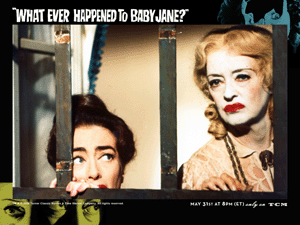
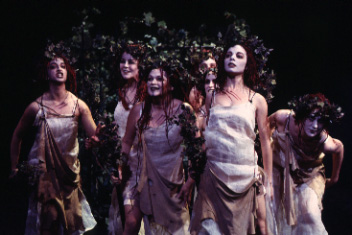 (from an American Rep production of "The Bacchae")
*********
So ravenm wrote this post critically comparing the full text of the Robin Morgan poem to Little Light's.
The gist of ravenm's critique, and I agree with her, is that the real difference between the two works isn't even so much in approaches to feminism or gender, or in the fact that they are talking about different experiences, but in fundamental philosophies of life. This is Morgan's conclusion:
You've already taken me away from myself
with my only road back to go forward
into more madness, monsters, cobwebs, nausea...
"May my hives bloom bravely until my flesh is aflame
and burns through the cobwebs.
May we go mad together, my sisters
May our labor agony in bringing forth this revolution
be the death of all pain.
May we comprehend that we cannot be stopped.
May I learn how to survive until my part is finished.
May I realize that I
am a
monster. I am
a
monster.
I am a monster.
And I am proud.
*****
and this is LL:
"There is too much to do, too much to love, too many who need one more of us to say hell no and help them say the same.
...It is time to look the monstrous in the eye. It is time. It is time to say that we are beautiful in our fierceness, and that we are our own. We are not the rejected of what we can never be. We are what we were meant to be. We are not pieces of wholes thrown together incorrectly. We are not mistakes.
We are not inferior knockoffs of someone else. If our monstrousness is frightening, then it is time we bare our teeth and draw that fear close to us and stop being so afraid of our fearsomeness that we fear everyone and everything else right back.
I am throwing my head back, here, and saying it: no more being afraid. Hell no. My monstrousness is not a place of shame. It is a strength. It is the power to say I am mine, and I will tell you what I mean. Not you. I am not any thing trapped in anyone's body. I am tougher than that, and I have plenty of blood to spare in this body of mine, and plenty more miles to go before any of you can bring me to my knees, and I dare you to try.
I am choosing to stay here, and it is mine to choose. And if that means changing shape, if that means putting together the unexpected, that is any monster's ancient right. It is damn well traditional.
The only ones setting traps are the ones in our way.
There. There's my teeth. There's my cause.
Boo.
Hiss.
Keep kicking: a thousand, thousand slimy things lived on. And so. Did. I."
*****
The former is coming from a place of despair and pain and defiance, yes, but not much more; the latter has a joyful fierceness and a sense of affirmation that is missing in the former. As Ravenm notes, LL's post is about the choice to embracelove and solidarity and to rejoice in our differences.
At raven's, and elsewhere, i think we've mostly been talking about the ways in which these approaches to -difference- well, differ; here i want to talk about the flip side of that, the different approaches to "love and solidarity."
May we go mad together, my sisters
May our labor agony in bringing forth this revolution
be the death of all pain.
versus
We are what we were meant to be...If our monstrousness is frightening, then it is time we bare our teeth and draw that fear close to us and stop being so afraid of our fearsomeness that we fear everyone and everything else right back.
The latter strikes me as an eminently democratic and positive approach to "solidarity:" "we are what we were meant to be." "We have nothing to fear but fear itself." There is room for tolerance, there; there is room for more than one possible outcome; there is the possibility of not just surviving but thriving.
The former--well, it's a bit nihilistic sounding, isn't it?
May our labor agony in bringing forth this revolution be the death of all pain.
So, the best "we" can hope for is one last round of sweet agony bringing forth a better world for -someone- (and they'd better be grateful, dammit, after all the work we've had, the sacrifices we've made, gestating and bringing it, them, to term); and the "death of all pain." which is, pretty much, just plain death, on account of life, she is painful. Not -only- painful, ideally, but then...well, perhaps that's the point, isn't it.
But besides even that, okay, what i wanted to talk about:
May we go mad together, my sisters
Here's my question. Why?
No, seriously. Why is this a good?
Based on the rest of the poem, my no doubt cynical and patriarchy-fucking first thought is this:
once again, this is "I want you to hurt like I hurt."
I mean, if you -already- hurt like the author hurts, then it makes a lot of sense. If not, though, there kind of isn't an entry point. And as LL's poem makes clear, even if you -do- hurt (for make no mistake, that piece is born of pain as much as the other), Morgan's solution is not the only solution. But, apparently, for her here, it is. And, to at least alleviate the isolation,
"May we go mad together, my sisters."
Sisters.
Because sisters, they/we love each other unconditionally; and, like birds in their/our little nests, agree.
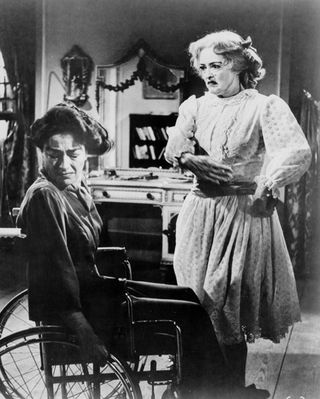
Hokay.
Well, you know what this reminded me of, besides QD/BL's recent piece entitled Dark side of sisterhood,
is this (relatively) little-known indie horror flick. Ginger Snaps.
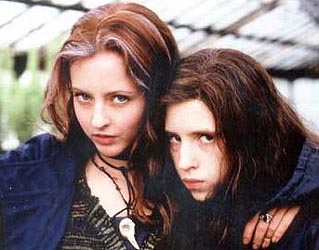
Capsule plot summary: two rather gothy-geek sisters, Ginger and Brigitte, are bonded over their mutual loathing of high school, people in general, and their love of gory horror films. One fine day Ginger, the older one, gets bitten by a werewolf, and it's up to the younger one, Brigitte, to try to find a cure and save her (and the rest of society) from herself before it's too late. (Unlike movies where the bitten morphs into a wolf at the full moon and is normal the rest of the time, in this world the werewolf changes slowly but inexorably from human to savage beast over a course of days or weeks, until the transformation is complete and permanent).
There is a thoughtful and fairly in-depth scholarly article on feminist readings of this movie, here, if such things interest you (talks about Kristeva and the "abject" and alla that).
And it is true that there is a -lot- to talk about in this movie in that regard, most obviously having to do with the in-your-face- metaphor of "werewolf" for "female coming of age." Not just the "curse" (oh ha, ha) and all the blood running from various sources, but: Ginger grows hair in unexpected places; has horrible pains--actually her menarche sets in at the same time as the other, more supernatural "curse" ("Just so you know, the words 'just' and 'cramps'--they don't go together"); develops strange and aggressive appetites having to do with boys (although pretty quickly, after not just basically ravaging but seriously biting a boy during a makeout sessions, Ginger realizes she's gone beyond lustiness:"I get this ache... And I, I thought it was for sex, but it's to tear everything to fucking pieces"). And so on.
But what really interests me here, and why I'm bringing it up, is the strange bond the sisters have. Even before the wolf enters: it's not shall we say the -healthiest- relationship in the whole world. Not in a pulp fiction, "strange sisters" sort of way; more in a "Harris and Klebold" sort of a way. Yeah, sure, the gothy melodrama is very high school; people can and do grow out of such stuff as
GINGER: Out by sixteen or dead in this scene but together forever. Together forever.
BRIGITTE: United against life as we know it.
...but, this movie is, among other things, a smart look into what happens when someone -doesn't- grow out of it, for whatever reason. Call it the wolf, or the beast, if you like; it's -something.- But, there is a rather malignant regression happening here,
(
[much later, after Ginger's been bitten, is half mad and blood soaked and bearing down on a terrified but still defiant Brigitte]
GINGER: You swore we'd go together, one way or another.
BRIGITTE: When we were eight.)
...when Ginger moves from her ordinary misanthropy to outright violence; and, even more to the point, when she insists ever more strongly on not just -protecting- her little sister, being -jealous- of her little sister's attempts to separate (which were already happening), but trying, needing to draw her down into that abject, -mad- place with her.
And once Ginger gets to the actual killin' and eatin', it starts to go to some very disturbing places indeed:


[as they're burying the popular girl who was one of their former tormentors, and whom Ginger's just killed, under the shed]:
GINGER: Think she's pretty?
BRIGITTE: If I wasn't here would you eat her?
...but, under all the blood and gore and guts and hormones gone haywire is something even more disturbing: there is a psychic transaction that's happened, one where Ginger swallowed Brigitte, or attempted to, long before she ever considered literally dining on human flesh. She treats Brigitte like an extension of herself, in other words. And while in the beginning Brigitte is content to be in her big sister's sometimes hurtful but always protective shadow, by the end of it she realizes just what a bad bargain they've made:
[after Brigitte cuts her palm]
Brigitte: You wrecked everything for me that isn't about you.
[Brigitte cuts Ginger's palm, exchanges blood with her]
...
Brigitte: Now I am you.
Ginger: I know you are. But what am I?
It's sealed in blood, but in a way it doesn't matter: the infection has already happened. Brigitte is too merged with her sister to give up on her, even when it's obvious that Ginger is too hopelessly far gone to save. And, it'd be spoiling not only this movie but the sequel to say more, but, just: it's a horror movie. The ending ain't happy. And this little exchange is why.
And, in the end, it's truly horrible, because, unlike Ginger, Brigitte sees through her own doom as well as her sister's with open eyes; she loves her, but she knows that in a way, while her sister "loves" her back, it's a selfish, self-absorbed love, where the only way to retain that love is to agree to merge with her. To get sucked into her pain and emptiness.
GINGER: I said I'd die for you!
BRIGITTE: No. You said you'd die with me. Cause you had nothing better to do.
Which brings me full circle back to why I prefer Little Light's work. Because, she does have something better to do. Because, her invitation is an honest one: to join her as an equal, to -connect,- not to get sucked in. Because she can stand on her own two feet, however "monstrous," and allows that her allies and comrades can do the same.
So, I'm with Little Light. However she ends up wanting to frame her approach to gender or anything else.
As long as that is the bargain. I and you may be "we," but we are also "I and you," and that is a good thing. And that makes me think maybe I'm okay with "we" with this person, and not the one who want "us" to "go mad together."
Because she has something better to do, and so do I.
And because maybe, after all, "monstrous body" or not, on another level, it's really true:
Better to light a candle than curse the darkness.
Sunday, August 06, 2006
Beat me to it
I was gonna write up some thoughts on Little Miss Sunshine, but Laurie Toby Edison of body impolitic said pretty much what I would've.
As she notes, to talk about the part I'd (also) wanted to talk about--some rather pointed irony about the grotesque kiddie beauty pageant--inevitably spoils the ending. So I'll just say: if you don't mind spoilers, or if you've already seen it, go check out what she has to say. I'll wait here. The rest of you: it's worth seeing.
As she notes, to talk about the part I'd (also) wanted to talk about--some rather pointed irony about the grotesque kiddie beauty pageant--inevitably spoils the ending. So I'll just say: if you don't mind spoilers, or if you've already seen it, go check out what she has to say. I'll wait here. The rest of you: it's worth seeing.
Tuesday, July 25, 2006
Prada, Schmada: The Devil wears your soul as an overcoat
...and then mocks you for your nakedness, and blames you for the cold.
Yeah, I saw the movie. Twice, as it happens, even though I thought it sucked the first time through. Why? 1) desperate need of air conditioning 2) the only other option, the one I'd paid to go into, was The Watery Vaguely New Age Tart by M Nachas Ramalamadingdong or whoever it is; twenty minutes of that and Devil Wears Prada was lookin' positively Felliniesque. Orson Welles and Billy Wilder all wrapped into one, dude.
and it did have Meryl Streep, who is, as she often is, worth the price of admission all by herself. The actor who plays the British assistant is funny, too.
All in all I tend to agree with this Pajiba review That is, to wit: the book (which I also read this week, sitting in the air conditioned Barnes and Noble; if you are detecting a subtext here, Gentle Reader, you are not wrong) was good bitchy fun; the movie watered it down and poured treacle all over it. The end, especially...
Well, without giving it away. Let's just say that my experience of pathological fucking narcissists and their enabling toadies is rather different.
Paradoxically, I realized afterward, this is one of the few instances where giving a character more depth and layers than she had in the book actually made the story less realistic and compelling. Some people really are completely two-dimensional; there is no there there; that's the whole point. That's what makes them so frigging deadly.
Although. The methods "Miranda" used in both the book and the movie were actually pretty dead-on. As were the ways in which people tend to respond to them.
It goes something like this:
1) Act completely unpredictably. People naturally respond in a certain way to what's called "intermittent reinforcement;" it's the same transaction that keeps gamblers and addicts hooked. And lab mice. Push the button, get a food pellet; predictable, you'll only push the button when you're hungry. Push the button, nothing ever happens; pretty quickly you'll stop pushing it and try something else. Push the button and every once in a blue moon, at random times, you get a pellet; you'll keep pressing that sucker till you drop dead from exhaustion.* Not even because you're that hungry, necessarily; because you're now convinced that you must have done something right (ahhh) to get that special payoff; and clearly it is a very special payoff, simply because it is so rare. Now if only you can just figure out what it is you did, so you can do it again.
*Which comes in really handy during those sixteen hour days.
1a) Sooner or later, hunger and exhaustion will become self-reinforcing tools in themselves, as they tend to make you weak and suggestible and put you in something of an altered state.
2) Be so unspeakably vile and abusive that even the faintest sign of a glimmer of a nod of humanity seems like an immense payoff.
2a) Scare the crap out of people; your goal is not to get them to "like" you; your goal is to get them to do whatever you want because anything is preferable to your awesome, terrible wrath.
2b) (this is actually one of the few places where i thought the movie got it more right than the book): If you can convince your victim erm target erm...well, anyway...that they're "special," that you only treat them so badly because you see something in them, they'll be yours for life. Fear alone will only get you so far. Fear plus the promise, however faint, of approval, even love...ahhh. Kingdoms are built on that.
3) Have some sort of talent; act in such a way that all but convinces people that nobody else can do what you can. Sell yourself as an amazingly precious and rare commodity.
(Tag line throughout: "A million girls would kill for this job.")
This is how abusive relationships of all sorts work; this is how cults work. And incidentally it maaayyyy just have something to do with advanced capitalism...of which the fashion industry, at least as presented here (and there seems to be a consensus that this is not an exaggeration), is one of the more bluntly raw examples.
Or, well. A million girls would kill for this job. Jobs are scarce, and this one is SPECIAL. And most people couldn't hack working for such a tough boss. But you might just be one in a million; doesn't that feel good? Everybody wants to look like that. Most people can't afford those clothes, that degree of thinness. But, ahhh, the splendid splendid warm glow of specialness to know that YOU can.
Or, in the words of Eve Harrington:
Imagine... to know, every night, that different hundreds of people love you... They smile, their eyes shine - you've pleased them, they want you, you belong. Anything's worth that.
Including your soul.
And the devil may not wear Prada, after all.
You might find the devil in academia. In finance, wearing a bowtie. Or, well...
But however the devil clothes hirself, rest assured:
It came off your back.
That's how you know it's the devil.
When you feel the chill.
Yeah, I saw the movie. Twice, as it happens, even though I thought it sucked the first time through. Why? 1) desperate need of air conditioning 2) the only other option, the one I'd paid to go into, was The Watery Vaguely New Age Tart by M Nachas Ramalamadingdong or whoever it is; twenty minutes of that and Devil Wears Prada was lookin' positively Felliniesque. Orson Welles and Billy Wilder all wrapped into one, dude.
and it did have Meryl Streep, who is, as she often is, worth the price of admission all by herself. The actor who plays the British assistant is funny, too.
All in all I tend to agree with this Pajiba review That is, to wit: the book (which I also read this week, sitting in the air conditioned Barnes and Noble; if you are detecting a subtext here, Gentle Reader, you are not wrong) was good bitchy fun; the movie watered it down and poured treacle all over it. The end, especially...
Well, without giving it away. Let's just say that my experience of pathological fucking narcissists and their enabling toadies is rather different.
Paradoxically, I realized afterward, this is one of the few instances where giving a character more depth and layers than she had in the book actually made the story less realistic and compelling. Some people really are completely two-dimensional; there is no there there; that's the whole point. That's what makes them so frigging deadly.
Although. The methods "Miranda" used in both the book and the movie were actually pretty dead-on. As were the ways in which people tend to respond to them.
It goes something like this:
1) Act completely unpredictably. People naturally respond in a certain way to what's called "intermittent reinforcement;" it's the same transaction that keeps gamblers and addicts hooked. And lab mice. Push the button, get a food pellet; predictable, you'll only push the button when you're hungry. Push the button, nothing ever happens; pretty quickly you'll stop pushing it and try something else. Push the button and every once in a blue moon, at random times, you get a pellet; you'll keep pressing that sucker till you drop dead from exhaustion.* Not even because you're that hungry, necessarily; because you're now convinced that you must have done something right (ahhh) to get that special payoff; and clearly it is a very special payoff, simply because it is so rare. Now if only you can just figure out what it is you did, so you can do it again.
*Which comes in really handy during those sixteen hour days.
1a) Sooner or later, hunger and exhaustion will become self-reinforcing tools in themselves, as they tend to make you weak and suggestible and put you in something of an altered state.
2) Be so unspeakably vile and abusive that even the faintest sign of a glimmer of a nod of humanity seems like an immense payoff.
2a) Scare the crap out of people; your goal is not to get them to "like" you; your goal is to get them to do whatever you want because anything is preferable to your awesome, terrible wrath.
2b) (this is actually one of the few places where i thought the movie got it more right than the book): If you can convince your victim erm target erm...well, anyway...that they're "special," that you only treat them so badly because you see something in them, they'll be yours for life. Fear alone will only get you so far. Fear plus the promise, however faint, of approval, even love...ahhh. Kingdoms are built on that.
3) Have some sort of talent; act in such a way that all but convinces people that nobody else can do what you can. Sell yourself as an amazingly precious and rare commodity.
(Tag line throughout: "A million girls would kill for this job.")
This is how abusive relationships of all sorts work; this is how cults work. And incidentally it maaayyyy just have something to do with advanced capitalism...of which the fashion industry, at least as presented here (and there seems to be a consensus that this is not an exaggeration), is one of the more bluntly raw examples.
Or, well. A million girls would kill for this job. Jobs are scarce, and this one is SPECIAL. And most people couldn't hack working for such a tough boss. But you might just be one in a million; doesn't that feel good? Everybody wants to look like that. Most people can't afford those clothes, that degree of thinness. But, ahhh, the splendid splendid warm glow of specialness to know that YOU can.
Or, in the words of Eve Harrington:
Imagine... to know, every night, that different hundreds of people love you... They smile, their eyes shine - you've pleased them, they want you, you belong. Anything's worth that.
Including your soul.
And the devil may not wear Prada, after all.
You might find the devil in academia. In finance, wearing a bowtie. Or, well...
But however the devil clothes hirself, rest assured:
It came off your back.
That's how you know it's the devil.
When you feel the chill.
Wednesday, March 15, 2006
Grisly, man.
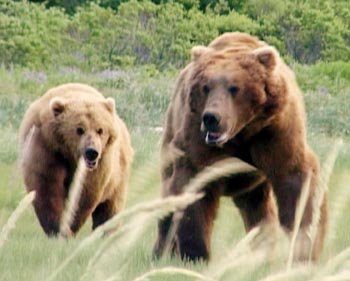
So I just saw the DVD of "Grizzly Man," the Werner Herzog documentary about a man, Timothy Treadwell, who had lived amongst the b'ars every summer for thirteen years. Then, one fine day, one of them up and et him. The movie contains a goodly amount of Treadwell's own film footage as well as post-mortem interviews with those who knew him.
The story is, I think, viewed as a tragedy of sorts, at least by some of the reviewers and probably by the director: one man's obsessive hubris leading to the inevitable fall. The crossing of boundaries man was not meant to cross: nature, red in tooth and claw, gets you in the end. Or at any rate, it got Treadwell. Or, at any rate, the bear part of it, got him.
And all of that was there, certainly. I gotta say, though, that by the end of it I was left with two thoughts that overshadowed all other impressions:
1) Go, bears!
2) GodDAM but the closet leads to some weird-ass places. And that ain't Narnia, neither.
No, okay, one shouldn't make these cynical, stereotyping assumptions. Just because the guy came off like Richard Simmons to the tenth power doing "Wild Kingdom" doesn't mean anything about his sexuality, of course. (or Simmons' either, for that matter; I seem to recall he's a straight fella himself, on the record). In fact, Treadwell goes out of his way to talk about how hard it is for him, with the ladies; and how it's so much easier for gay folks:
"You know, it's just Bing! Bing! Bing! - gay guys, no problem. They go to restrooms and truck stops and perform sex, it's like so easy for them and stuff."
He goes on to say that he always wished he were gay, Treadwell did, but, sigh, it just wasn't meant to be: he's straight straight straight, dammit. He loves the ladies. But they don't love him. That same sad song so familiar to all the other straight dudes out there. Good thing he has his animal friends, for consolation. Specifically, big, muscular, hairy, do-what-comes-nat'rally...bears. Who don't even need a restroom or a truck stop, let alone anyone's permission, to do their thing, be it sex or rasslin' or just plain takin' a dump. It's, like, so easy for them, and stuff. Bears, that is.
At any rate it didn't seem like he had trouble attracting women to share his life with him, Treadwell; in fact he had one girlfriend, Annie Huguenard, who shared his death. Did she, in fact, die for him? Well, she certainly died with him, which is pretty damn intimate, I'd say. No one seemed to know much about her, in the film; the speculation was that she could have made a run for it at the last, but didn't, which implies a heroism of sorts, I suppose. Personally I have no idea how I'd react if I were stuck in the middle of fucking nowhere with an extra-manic Richard Simmons and a shitload of bears, let alone what I'd do when one of the bears finally cashed in that all-you-can-eat-buffet coupon on my companion. I imagine I'd be too busy crapping myself and screaming to figure out an escape, but who the hell knows?
The real question, of course, is why on God's green earth does a nominally straight woman take up with Richard Simmons Gone Wild in the first place? According to the people who knew Huguenard, she was frightened of the bears, so it wasn't like she was completely at one with him in his amateur naturalist enthusiasm (and/or his insanity, depending on one's point of view and/or one's degree of charitability toward Treadwell).
Personally, I blame the patriarchy, (cough) for all of it. Socialization of women to take care of everyone but themselves, to play nice and not say "You want me to camp out where?! Screw you guys, I'm goin' home." Socialization of men so that it seems more acceptable, easier, somehow, to be a platonic bear-lover and eccentric martyr than to just do one's thing--in truck stops, or restrooms, or anyfuckingwhere but a protected campground full of projections of idealized love in the form of wild animals (who, as the director notes, frankly don't seem to see Treadwell as anything but a potential snack, ever, despite Treadwell's cutesy nicknames and protestations of deep psychic bonding with the critters).
And finally, there's the whole romanticization of innocence business, which I think is at the heart of Treadwell's trip. You know: humans are corrupt or too complicated or sinful, or something, so clearly the solution is to reject one's ties with the greater body of humanity. Turn away altogether, put all of one's needs onto Nature (with a capital N). Or--now extrapolating to others I think have taken versions of this trip, and perhaps for similar reasons--Michael Jackson, say--children. Or perhaps even aliens: witness the Heaven's Gate people, or at least their leader, Marshall Applewhite. Applewhite the idealist, Applewhite the gentle eccentric, Applewhite the guru, who was charismatic enough to find a number of other pure, shining, selfless souls to merge and go all the way to the Light with him. Would Huguenard have eaten the Nembutal-laced pudding if Treadwell had asked her, I wonder? At least it would've been a less painful way to go than being mauled and eaten alive.
Cases like these guys are fascinating because they take certain threads in the cultural zeitgeist to their logical, if extreme, ending. At any rate it's not at all hard to draw from the ah "traditional values" template, current American version(s), and conclude that there's something fundamentally wrong with us mere mortals. Something that needs fixing, or running away from. Maybe even killing.
And yet, for all of Treadwell's attempts to merge with the "animals," it's not at all clear that it ever occurs to him that humans are animals, too. And, by extension, that he, too, is already an animal, no more or less than the rest of us--and that that might actually be O.K.
By the way, this Slate review of the film is really good, and I agree with Edelstein's take, on the whole. (Corky St. Clair, yes! even more than Simmons)
Saturday, January 21, 2006
King Kong is a ding dong
Although you may want to take my take with a fair helping of salt.
Confession #1: I walked out, about 2/3 through. Although it's just barely possible that one of these days (most likely when it comes out on DVD) I'll go to the trouble of seeing that last hour. Maybe.
Confession #2: I may be one of the only people in western civilization who never saw the original(s) and in fact hadn't known much about the plot before I saw this one (and then later read the reviews). The gist and the big finish, sure; but I hadn't ever really known how they got there.
Which means that I had always assumed that the racism people attribute to the movie only had to do with the subtext (what with the brute's ravishing of the delicate blonde and all). I hadn't known there was also that whole "savages in the jungle" scene. And I certainly didn't expect that level of...well, savagery.
I find myself agreeing with the camp that suspects Peter Jackson was (at best) not really being very conscious here. For one thing, there is that one noble black guy, the first mate (the only non-white in the picture who couldn't be mistaken for an extra from "Dawn of the Dead"), who not only dies whilst heroically saving his white comrades and protege, but telegraphs his death for a good five minutes before the inevitable denouement. "Run, you fool!" I wanted to shout. Then I dropped my four-dollar water bottle, and promptly forgot about his or any of the other characters' problems, as ultimately I didn't really give a shit about any of them. Which was really the bottom line, for me; but, I'll get there in a sec.
Then, too, it seemed to me that the demonic natives looked just an awful lot like Jackson's orcs.
That wasn't enough to drive me out of my seat, though; what finally did it was that I just wasn't having any fun. And yes, the CGI was astounding, especially Kong himself (and that's the only reason why I'm just a tiny bit sorry I didn't stay till the end). Visually it was a treat. I think if I'd had more understanding of exactly went into all those amazing effects I'd probably have appreciated the whole thing a lot more. Also probably would be true if I were a film buff and understood all the nods and homages and so on.
But, I'm not. And, taken on its own terms and not as a beloved classic or a visual tour de force, the movie simply didn't work for me. Too overblown to be camp and too preposterous to be anything else. I didn't even enjoy it on a "thrill ride" level, and it's not that I don't ever like such movies. I thought "Jurassic Park" was completely daft but it still had me jumping out of my seat, for instance (from which film the best action sequences in this film seemed directly ripp'd). Whatever it is that Spielberg does to make you suspend and jump and scream, Jackson doesn't have it, at least not here.
And without the "AAHHH!" factor, the Skull Island stuff just seems ridiculous. I mean, come on, I heard myself saying out loud, a number of times. What the fuck is that chick made of, anyway? Silly Putty? If you don't want to show the full-body bruises and crushed ribcage that (at least) istm would inevitably result from being clutched in a giant paw and flung about at dizzying speeds, not to mention the whole vines-and-narrow-escape-from-being-a-dinosaur-hors-d'oeuvre sequence, well okay (she is a dancer after all, and hence rather agile and springy); but jeez, something. Projectile vomiting from the vertigo, perhaps? It's not like it would've added significantly to the "ick" factor. Was her lingerie even mussed?
And "come on" was also my reaction wrt the characters and their actions. Starting with: *why* the fuck doesn't the screenwriter just jump off the goddam boat? I mean, seriously? Okay, it's not exactly naturalism here, but surely if it's supposed to be that he, like the crazy/smarmy director, is motivated by the fine, dark love of adventure, it wouldn't be too much to ask that they establish something to that effect? Even a comic book character deserves that much. And if it's the glamour of film that's drawing him away from not just his play rehearsals but his whole fucking life, well, it's pretty damn obvious that this is not a glamour flick. Not to mention the boat itself, and again I come back to my point about the curious lack of vomiting in this picture. As it is, he just looks, well, kind of lame. And while Watts is cute and all, I just do not buy that her limpid gaze, blonde locks, and winsome pratfalls are enough motivation for that entire fucking hardbitten crew to go on a blind chase after her into what sure as shit looks like certain death. And Jack Black...well, 'nuff said.
Ultimately I just found myself asking: why? Why remake this? Why tell this story? Yeah, it had really cool SFX possibilities (which were duly manifested), but so could any number of movies, old and new. Why this? Why now?
Even without the anvilicious Meaningful Display of "Heart of Darkness" (as read by a wide-eyed cabin boy) I was getting the impression that Jackson wanted to do "Kong" at least partly because something about that old subtext or narrative or whatever you want to call it still speaks to him. In both LOTR and this, now: it is a very heavily white and male cast, along with the odd fair maiden or so, heroically fighting off the forces of darkness, quite literally. Dark, filthy, subhuman savages (and one sort of noble savage, if you count the giant monkey). Not to mention dank caves and swamps full of icky sticky devouring spiders (and now Alien-styled worms as well). The horror, the horror...the symbolism.
I'm not saying Jackson intended any of this (I just don't know), or that the movies' worth depends on their political correctness...or at least awareness. I'm just saying: I don't think I relate, really.
Confession #1: I walked out, about 2/3 through. Although it's just barely possible that one of these days (most likely when it comes out on DVD) I'll go to the trouble of seeing that last hour. Maybe.
Confession #2: I may be one of the only people in western civilization who never saw the original(s) and in fact hadn't known much about the plot before I saw this one (and then later read the reviews). The gist and the big finish, sure; but I hadn't ever really known how they got there.
Which means that I had always assumed that the racism people attribute to the movie only had to do with the subtext (what with the brute's ravishing of the delicate blonde and all). I hadn't known there was also that whole "savages in the jungle" scene. And I certainly didn't expect that level of...well, savagery.
I find myself agreeing with the camp that suspects Peter Jackson was (at best) not really being very conscious here. For one thing, there is that one noble black guy, the first mate (the only non-white in the picture who couldn't be mistaken for an extra from "Dawn of the Dead"), who not only dies whilst heroically saving his white comrades and protege, but telegraphs his death for a good five minutes before the inevitable denouement. "Run, you fool!" I wanted to shout. Then I dropped my four-dollar water bottle, and promptly forgot about his or any of the other characters' problems, as ultimately I didn't really give a shit about any of them. Which was really the bottom line, for me; but, I'll get there in a sec.
Then, too, it seemed to me that the demonic natives looked just an awful lot like Jackson's orcs.
That wasn't enough to drive me out of my seat, though; what finally did it was that I just wasn't having any fun. And yes, the CGI was astounding, especially Kong himself (and that's the only reason why I'm just a tiny bit sorry I didn't stay till the end). Visually it was a treat. I think if I'd had more understanding of exactly went into all those amazing effects I'd probably have appreciated the whole thing a lot more. Also probably would be true if I were a film buff and understood all the nods and homages and so on.
But, I'm not. And, taken on its own terms and not as a beloved classic or a visual tour de force, the movie simply didn't work for me. Too overblown to be camp and too preposterous to be anything else. I didn't even enjoy it on a "thrill ride" level, and it's not that I don't ever like such movies. I thought "Jurassic Park" was completely daft but it still had me jumping out of my seat, for instance (from which film the best action sequences in this film seemed directly ripp'd). Whatever it is that Spielberg does to make you suspend and jump and scream, Jackson doesn't have it, at least not here.
And without the "AAHHH!" factor, the Skull Island stuff just seems ridiculous. I mean, come on, I heard myself saying out loud, a number of times. What the fuck is that chick made of, anyway? Silly Putty? If you don't want to show the full-body bruises and crushed ribcage that (at least) istm would inevitably result from being clutched in a giant paw and flung about at dizzying speeds, not to mention the whole vines-and-narrow-escape-from-being-a-dinosaur-hors-d'oeuvre sequence, well okay (she is a dancer after all, and hence rather agile and springy); but jeez, something. Projectile vomiting from the vertigo, perhaps? It's not like it would've added significantly to the "ick" factor. Was her lingerie even mussed?
And "come on" was also my reaction wrt the characters and their actions. Starting with: *why* the fuck doesn't the screenwriter just jump off the goddam boat? I mean, seriously? Okay, it's not exactly naturalism here, but surely if it's supposed to be that he, like the crazy/smarmy director, is motivated by the fine, dark love of adventure, it wouldn't be too much to ask that they establish something to that effect? Even a comic book character deserves that much. And if it's the glamour of film that's drawing him away from not just his play rehearsals but his whole fucking life, well, it's pretty damn obvious that this is not a glamour flick. Not to mention the boat itself, and again I come back to my point about the curious lack of vomiting in this picture. As it is, he just looks, well, kind of lame. And while Watts is cute and all, I just do not buy that her limpid gaze, blonde locks, and winsome pratfalls are enough motivation for that entire fucking hardbitten crew to go on a blind chase after her into what sure as shit looks like certain death. And Jack Black...well, 'nuff said.
Ultimately I just found myself asking: why? Why remake this? Why tell this story? Yeah, it had really cool SFX possibilities (which were duly manifested), but so could any number of movies, old and new. Why this? Why now?
Even without the anvilicious Meaningful Display of "Heart of Darkness" (as read by a wide-eyed cabin boy) I was getting the impression that Jackson wanted to do "Kong" at least partly because something about that old subtext or narrative or whatever you want to call it still speaks to him. In both LOTR and this, now: it is a very heavily white and male cast, along with the odd fair maiden or so, heroically fighting off the forces of darkness, quite literally. Dark, filthy, subhuman savages (and one sort of noble savage, if you count the giant monkey). Not to mention dank caves and swamps full of icky sticky devouring spiders (and now Alien-styled worms as well). The horror, the horror...the symbolism.
I'm not saying Jackson intended any of this (I just don't know), or that the movies' worth depends on their political correctness...or at least awareness. I'm just saying: I don't think I relate, really.
Monday, December 19, 2005
Saw "Brokeback Mountain" last night
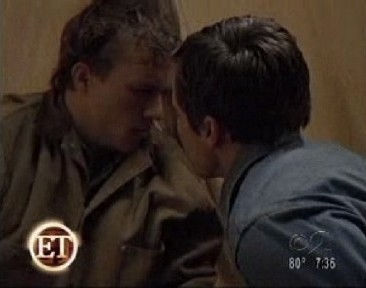
It really did live up to the hype. It's devastating. It's also done without the word "gay" or "homosexual" being uttered once. I think "queer" comes up, once, early ("I ain't queer.") But then a lot of the movie is about just how much is said without words. In some ways I think it's about subverting the myth of the "strong, silent man" archetype as anything else. By the end you're aware of just how much soul crushing goes into the energy it takes to clench that jaw.

"You can't fix it, so you've got to stand it."
And there's nothing romantic about that stoicism, either. It's just awful.
It's possibly the first mainstream movie I've seen which lays out the profound damage that goes along with repressing such a fundamental part of your personhood--and not just to oneself, either. You can tamp down or even kill off your love and your longing, but you can't cherry-pick which parts of your heart will die in the process.
Also, brilliantly acted, stunningly shot--it was smart, and soulful. And sexy, very, even amid the starkness--in an adult, character-revealing way, too, I thought, het and homo scenes alike, which is very rare indeed. More of that, please, Hollywood.
Monday, November 28, 2005
Narnia lip, there, pal.
So what if it's from Disney. So what if some people want to claim the film as a vindication for "Christian moviemaking" and C.S. Lewis as an allegorical prophet--hey, at least presumably Aslan's death isn't a protracted snuff film. So what if, visually stunning as the previews look, the magnificent lion still seems, well, a teeny bit risible, when it opens its jaws and starts to talk in that genteel British voice. It's mythic! It's seminal! It's got Tilda Swinton as a nine-foot tall dominatrix! I am so there.
Subscribe to:
Posts (Atom)


